Author: Karen Redick

Sod or Seed?

What is the best way to get that carpet of green lush grass that everyone loves? The choice you make between sod or seed depends upon a few factors.

The first is usually the price. Seed is definitely the less expensive option. With sod you are paying for the labor of the sod farm to raise and care for the grass as it grows into that lush carpet that provides you with instant gratification.
Which leads us to our second factor, your time frame.  If you are in need of that instant gratification you will certainly want to choose the sod over the seed.  Even assuming you are planting in the prime planting seasons (late spring or early fall) grass still takes several weeks to grow and it will NOT look like a lush green carpet right away. There WILL be weeds and it may even take a few seasons and lots of fertilizer to achieve the lush carpet echelon.

Third factor to consider is typically the site conditions; seed gives you more flexibility in the sun vs. shade varieties, or a mixture, while sod is normally the sun-loving strain. If your lawn is not flat and has steep slopes you might also want to spend the extra money for sod since the seed will very often get washed away in the rain.

Keep in mind that when you ask your contractor to install seed instead of sod that you are assuming the risk of the final outcome.  Unless the contract (and price) specifically states otherwise, YOU are now the caretaker of the new peach fuzz grass sprouting in your lawn and you are NOT allowed to withhold payment for laying the seed until such time as your peach fuzz resembles a lush green carpet – it is a simple risk/reward situation.

Recent Posts
Follow Us

Continue reading

WEED is a Four-Letter Word!

These are nasty things, weeds. There is a reason they are called noxious, whose synonyms include such words as unhealthy, corruptive and detrimental.

And yet, the battle goes on… Does anyone ever win the battle against weeds?  Only the most diligent and dedicated warriors can, I assure you.  Many people assume that applying a nice thick layer of mulch is the solution to all their problems – not so fast! Yes, the mulch blocks the sunlight and it might work in the short term, but those weeds will eventually grow up through – and even with a plastic barrier beneath they will just start taking root in the mulch itself.

In the long term, the best solution to combat the weed problem, at least in the lawn area, is a thick and healthy lawn – it’s another one of life’s “Catch-22’s,” isn’t it? Weed control can vary depending upon the location you are  trying to protect or reclaim.  In a planting bed mulch is the obvious front line of defense, especially since it has the added benefit of locking in the moisture the the plants and flowers you DO want. But for the lawn areas it becomes a bit more problematic since the best weapons in both the “chemical” and “natural” categories will surely kill the grass as well.  

One of the most well-know non-selective chemical weed killers is Round Up and on the natural side of the equation the most effective seems to be vinegar, salt, bleach or boiling water. But for an already established lawn you might prefer to use a chemical application that is specific to the type of weed or group of weeds but will not harm the grass. But this also is not a sure thing as you need to be aware of the appropriate product for your type of weed, the stage of growth of the weed and the particulars for the application, like safety precautions for children and pets or even the chance of rain!

You may not want to hear this but the most effective ways to remove weeds is using good old fashioned elbow grease and pulling them by hand or with a hand tool.  Sorry. There is an abundance of different types of weed fighting tools to choose from. So you can try to take the easy way out and use an application of some sort (or call your local Green Thumb guy) or you can roll up your sleeves, get some sun and exercise, and get to work!  Good luck in your battle with the weeds.

Recent Posts
Follow Us

Continue reading

Understanding the Value of Design

It can be difficult sometimes to comprehend the value of good design. 

Some clients get the concept right away that investing that little bit of time and money NOW will save you so much time, money and frustration LATER. Other clients have already been through a project and learned the lesson the hard way.  So many times we are called in a year or two after work has been done by the “least expensive” contractor to fix and replace their work. It makes you wonder if they have ever heard the old adage “Do it right the first time”.

Why is it so hard to comprehend the monetary and aesthetic value of good design?  Not just landscape design, but all design.  I am sure that architects, interior designers and even engineers experience this conundrum.

The root of this this problem most likely lies in the concept of “design”.  Most people already have a good idea/image in their mind of what they want, so to spend money for someone to simply draw that idea on a paper seems extravagant and without merit. That would be true if that is all there was to design.  

In reality, the design process is much more complex and comprehensive so that the resulting construction process is that much more uncomplicated and efficient.  All the salient details are considered so that local codes are complied with, construction details are not overlooked, the appropriate materials are chosen and the subcontractors are not duplicating efforts.  

For those contractors that do not do such a thorough job, of course their “number” is going to be lower, but so is their quality, and in the end, so will the client’s bank account!  To borrow a quote from one of our colleagues, “If you think hiring a professional is expensive, just wait to see how much an amateur is going to cost you!”

Recent Posts
Follow Us

Continue reading

Heading to Your Local Nursery?

This time of year most people love to add a splash of color in the front or spruce up a section of the garden with some new plants.  Before you head out to the nursery you should at least take some mental notes and make some general decisions.

For example, are you looking for annuals or perennials? What location? Are you looking for shade, partial shade, or full sun plant material?  Size and shape, ie. growth habit of the plant material, is an important consideration – basically, are you looking for something that will grow tall or stay low and spread?  Evergreen or deciduous? Color preference? Soil type and water needs?

For a seasoned gardener, many of these considerations are automatic and instinctive. However, for a novice gardener or those prone to impulsive purchases (like myself…), thinking about these specifications in advance will save you LOTS of money, especially when you are dealing with perennials, trees or shrubs.  For example, a tree planted on the wrong side of the yard can die simply from not enough or too much sun. Or, a large fast-growing tree planted in the wrong location can cause serious damage to pavement or underground systems. 

Annuals tend to be a little less risky and expensive since they only live for one growing season. On the other hand, annuals only live for one growing season…so they are less economical in the long run.  Spend some time to think about your needs, talk to your local nurseryman and read the tags! 

Want to discuss your project in detail?

Start the Conversation

Recent Posts
Follow Us

Continue reading

Marigolds… You Either Love ’Em or Hate ’Em

The popular orange or yellow annual flower… is not one of my personal favorites… but why do so many people plant them?

Well, they are native to North America, they are very hardy (Hardiness Zone of 3 to 10), they are deer and rabbit resistant AND they even are said to be insect repellent.  Some species have a musky scent that, according to anecdotal evidence, helps keep the mosquitoes and flies away from your deck or patio. 

Marigolds are used in food colorings and as medicinal teas around the world. They are, however, considered to be a noxious invasive plant – possibly why so many people wisely use them as potted plants.

But I just don’t think they are that pretty…maybe from a distance and in large groupings… but to each his own, right?  They just look so much like carnations which bring back bad memories of high school dance corsages…  Go to our Facebook page and let us know what you think of Marigolds.

Recent Posts
Follow Us

Continue reading

Japanese Maple Transplant

Redbud is currently working on a project where the client wisely decided to try and save a beautiful old Japanese Maple tree. 

The tree is approximately 25 feet tall with a head diameter of roughly 25 ft as well.  In order to safely transplant this tree a specialist was consulted.  An enormous whole was dug around the base of this tree which allowed them to dig out the massive 12 foot root ball!  Check out the photos I posted to our Facebook page…

Recent Posts
Follow Us

Continue reading

Featured in Success Magazine: A Conversation with Redbud Development

  • As Seen in Success Magazine

Redbud Development is once again featured in Success Magazine. Read the full Q&A with Redbud Development owners, Geffrey & Karen Redick.

Success Magazine: Geffrey, you graduated from Cornell University with a degree in landscape architecture. Where did you gain your work experience?

Geffrey Redick: After school I worked in Glens Falls for Jim Girard Landscape Maintenance for four years and then moved down to Long Island where I worked for an award winning landscape design/build firm. It was an enlightening experience on both the construction and client relations side of the business.

SM: In 2004 you decided to take the plunge and start your own landscape design/build business with your wife Karen. What was your goal in founding the business?

Geffrey: It was definitely a combination of reasons and events, but mainly the draw of being my own boss and the opportunity to expand my creativity; I had built many things over the years, now it was time to build a business. But most important was the added flexibility of being present for the important stuff, like the first day of school.

SM: Karen, with an MBA in finance and a degree in international language and business, did you ever think owning a landscaping firm was in your future?

Karen Redick: Never! I really enjoyed working in New York City in the banking industry. The pivotal event was having our first child just days before 9/11/2001; this altered my perspective on life as I am sure it did for many other people. New priorities were set and a move to be closer to family completed the setting. Now I get to utilize my skills and energy to create beautiful environments in nature for families to enjoy. What could be better than that?

SM: How has your education and prior experience prepared you for a successful future as an entrepreneur?

Karen: My education has provided me with the basics of running a business as well as an appreciation of fine arts and culture. My work experience has been varied and taught me many things; from the operational side of running a small import company, to living and working and surviving (!) in several foreign countries, to managing in the high stress environment of the financial end of an international investment bank. Add to all that the skills learned from being the mom of three, such as scheduling, multi-tasking, problem solving, becoming a human resources expert….and I think we are all set and ready to go.

SM: What services do you provide? Geffrey & Karen: We help people create the outdoor space of their dreams and we fix a lot of problems along the way. These fixes can be in form or function. We can take your outside from boring to inspiring or we can transform your wet, mushy yard into a tennis court. Redbud Design is the landscape architecture side of the business where we can provide design only, consulting, and educational services. Redbud Development is the construction side of the business where we can provide clients with the full range of services needed for building the landscape project; sketch design, code compliance issues, permit applications, subcontractor selection, and oversight.

SM: What truly makes Redbud unique in this competitive industry?

Geffrey & Karen: Few other landscape contractors have the education and experience of a licensed professional to draw from. Plus we truly listen to our clients’ needs and collaborate with them and other design professionals, architects, and engineers to ensure the complete vision is achieved.

Start the Conversation

Recent Posts
Follow Us

Continue reading

Meet Redbud Development — Featured in Saratoga Today

  • As Seen in Saratoga TODAY Newspaper

Five years ago, Geff and Karen Redick decided that the time was finally right to realize the dream.

A graduate from Cornell University in 1993 with a degree in Landscape Architecture, Redick has over 15 years of experience in the landscape design field, having worked for several award-winning landscaping firms in Long Island and Glens Falls. Along the way Redick attained his certification as a New York State Registered Landscape Architect, and his longtime involvement in the industry gave him the confidence to take the next step in his career. In 2004 with the help of his wife, Karen, who has an MBA in Finance, as well as a degree in International Business and Foreign Language, the pair decided to start a landscape design and construction firm of their very own. They called it Redbud Development Inc.

In the five years since its formation, Redbud Development has taken on a wide array of projects and clients, helping residents in the Albany, Saratoga and Lake George Regions to reinvent their properties in ways they hardly imagined.

“Having my own company enables me to create and follow through with the construction of unique and interesting projects,” Redick said, adding that seeing such creative projects through to completion is his favorite part of the job.

Redbud Development takes on mostly residential landscaping and design jobs, although the breadth and scope of these projects varies drastically from client to client. “We can design and build virtually anything,” Redick said. “Projects can be as simple as an entrance walk, to elaborate full scale project management on the construction of driveways, garages, outdoor kitchens, stone retaining walls and much more; encompassing a full landscape package.”

Among some of the projects and designs that Redbud Development can help clients bring to fruition include the construction of patios, decks, custom fencing and perennial gardens. Redick’s firm has also helped customers realize larger projects, including (but not limited to) the installation of drainage systems, pool cabanas, audio and lighting systems, backyard playgrounds, tennis courts and even manmade ponds or water features. But above all, Redick said that his top priority is working closely with his client to ensure that they get exactly what they desire.

“Our first priority is to understand the client, who they are and what their needs are. Everybody has different desires and requirements. Some clients are all about safety for the children, some are more concerned about having adequate entertaining areas, while others want simply to enjoy nature in their yard and explore the possibilities of sustainable products.”

Geff Redick

“All of our designs derive from the client,” Redick said. “Our first priority is to understand the client, who they are and what their needs are. Everybody has different desires and requirements. Some clients are all about safety for the children, some are more concerned about having adequate entertaining areas, while others want simply to enjoy nature in their yard and explore the possibilities of sustainable products.” One of the tools Redick uses to get a better idea of who his clients are and what they need is in the form of a landscaping questionnaire, which Redick says he encourages his clients to consider.

“Really the goal behind the questionnaire is to start stimulating thought and dialogue from the client’s perspective. Typically most clients already have a sense of what they think they need. It will normally stem from something that’s problematic.

Their existing pool may be unsightly and they want to replace it or remove it completely. But they may not necessarily be thinking about what their options are, what different possibilities may be available to them,” Redick explained. “My hope is that a client may say to me that they want to replace the pool, but further discussion reveals that one of the things that they would really enjoy is the sound of water falling or the more natural look of a pond and with that a place to sit, relax, and hang out for a few minutes. If they start thinking about the space and thinking about what drives them personally, we can incorporate those simple little elements that make the project extraordinary”.

Redick said that his company likes to look at the bigger picture when it comes to the designs he provides to his customers, always making sure to keep his clients abreast of the various design ideas, concepts and corresponding costs before moving forward.

“As we go through the design process, we are bringing [the client] ideas and sketches of how we want to implement the design so that they can start seeing and get an appreciation for what the look of the project is going to be,” Redick said.

But the flexibility of customer relations doesn’t end there with Redbud Development. If customers have a larger project in mind, one that they hope to complete over several years time, Redick will work with them to design the project in phases, and plan the construction elements and out so that it takes a logical progression, is more affordable and convenient for the client.

“We try to take a very rational approach in our designing, so that customers can have their desires fulfilled over an extended period of time, but without costing them additional funds,” Redick said.

Traditionally, stepping stones were primarily functional, facilitating travel between the house and garden in rural settings. Each stone was strategically placed to ensure easy passage with every step. Today, while still serving their practical purpose, stepping stones have evolved into aesthetic focal points in gardens, gathering spaces, and patios.

The size, shape, color, and arrangement of stepping stones play a crucial role in defining the atmosphere of a space. In contemporary designs, sleek lines and symmetrical layouts dominate. Clean materials like slate, concrete, or flamed bluestone are popular choices for creating structured walkways and transitional zones.

Redbud Development Inc. is located at 2 Commerce Park Drive, in Wilton. For more information on Redbud Development, or to contact them for their services, parties are encouraged to visit them on the web at redbuddevelopment.com, or to contact them by phone at (518) 691-0428.

Start the Conversation

Recent Posts
Follow Us

Continue reading

The Landscape of Technology

Gone are the days of simply putting together some plants and grass and calling it a landscape. Today’s landscapes integrate technology along with plant materials in exciting ways, from built-in barbeques, pools, spas and multifunction athletic courts to customized outdoor audio, lighting, security, and irrigation systems.

More than being used as a finished element in the landscape, however, technology is now part of the landscaping process from inspiration through planning and construction. Consumers rely on the internet and endless cable TV programs for ideas and use computer programs to make simple plans. Landscape designers take even greater advantage of technology with sophisticated programs to design landscapes, integrate systems, ensure local code compliance, and coordinate with other building professionals. The sheer mass of the available technology is daunting, and while it makes innovative solutions in planning and design possible, integrating the various technologies adds another challenge to the planning and design process.

Sometimes employing the latest in high-tech products can empower consumers to move forward with the project of their dreams. For example, previous clients once had serious concerns about installing a pool in their backyard because of the potential safety problems relating to the couple’s two teenage children. It was important to the couple to be able to monitor the pool at all times, but this was impossible when both parents were working. The solution was to install a video camera that could be accessed via an internet video feed which the clients could monitor from their computers at work. Now this family is enjoying their pool and their security with the help of technology.

Another example of how technology can improve the planning and design process is in allowing professionals to communicate effectively and efficiently with their clients and each other. If your landscape designer uses the AutoCad program, he can easily share blueprints with architects, building contractors, and interior designers. Each of these professionals is immersed in their own field of design and products that are available to the consumer. The architect is typically focused directly on the house or building and pays little attention to what the client might be thinking about for the landscape. Proper coordination between the landscape professional and the architect can result in two separate projects that still fit together in both form and function. This planning process is further impacted by the regulatory growth and control our local governments are placing on our communities. For example, houses, pools, walls, etc… have to be set so many feet from a property line; fences are limited to certain heights and styles; and drainage requirements are new realities that need to be considered. All of these factors are made more manageable by computer planning and research.

The vast array of landscape options available through technology sometimes leads consumers to be overwhelmed with the size and complexity of a project. Sometimes the technology may even overshadow the importance of good design and creativity. A landscape designer will help you wade through options and decide what technologies are most appropriate for your landscape while implementing a creative design that’s both attractive and functional. Thorough planning can coordinate traditional landscaping elements with new technology and break even a large, complex project into manageable pieces. The end result of working through the design and planning process effectively provides you with a completed puzzle. All the pieces have a place within a landscape. The trick is to break down that plan into constructible parts. This puzzle can be completed as a whole project or can be pieced together over a period of time. Comprehensive planning allows you the ability to realize your dreams quickly or over a number of years.

Good planning also results in lower project costs due to the ability to perform the work correctly from the outset and laying the groundwork for future additions. For example, while designing your landscape you might plan to build a patio and install an irrigation system right away, but realize that at some point you would like to install an outdoor lighting and audio system, but probably not for a few years. While your patio and irrigation system are being built, a smart landscape designer will have a PVC pipe system installed underneath your patio and throughout your lawn during construction. When the time is right you can add your lighting and audio systems without ruining the lawn or patio. The best part is that when you get ready to actually install the new systems, the labor involved will be so small that you could probably do it yourself!

Consumers with a comprehensive plan can also be secure in the fact that their dollars are being spent wisely, knowing that work is being performed in a logical sequence. Nothing is worse for a consumer or professional than having to do work twice due to poor planning. Getting it done right the first time is essential. Consider the clients who want to install a pool and a new fence surrounding their property – two expensive projects. They decide to spread out their projects and do the fence this year so their kids and dog can run freely in the yard and to build the pool next year. They go ahead and pick out a fence they really like only to find out a year later that the fence does not meet the local code for pool safety, and that half the fence needs to be taken out to make room for the pool contractor anyway. This kind of situation is easily avoided with careful planning.

As we are bombarded with all of the exciting opportunities that technology makes available to us, we can be overwhelmed and lose sight of our true objective. Client and designer need to be careful to consider all the possibilities without losing sight of both the artistic and functional aspects of the project. As you watch home and garden television shows and peruse the internet, consider all the magical possibilities for your landscape, but please do not lose sight of the most important aspect of developing a project – good design and creativity!!!

Start the Conversation

Recent Posts
Follow Us

Continue reading

Stone Patio or Wooden Deck: Which is Better for Your Home?

Spending more time outside is never a bad idea. One of the best ways to enjoy the outdoor is relaxing on a patio or a deck. But which is better for your home — a stone patio or a wooden deck?

The answer is not as simple as it seems and involves careful consideration before investing in what is likely to be the focal point of your outdoor entertaining, play, and relaxation space.

Some people base their decision solely on their personal preference for the look of wood or the feel of stone. Personal preference, however, is only one of several factors to consider. Other factors include the intended function of the new space and what type of structure will work best with the style of your home. The setting of your property is a factor and whether you want to maximize your privacy or a great view. And the very important issues of maintenance and cost are always a factor in decision-making.

Plan Your Patio or Deck Space

When planning your new outdoor space, ask yourself several questions. Will you use the space for small family gatherings or for entertaining large groups of friends? Are your gatherings usually casual or formal? Will you use the space for reading the paper in the morning, sun tanning in the afternoon, or barbecuing in the evening? Do you have small children? The answers to these questions might already lead you in the direction of a material choice. Large, formal gatherings might seem more appropriate on a smooth, dimensional Bluestone patio, whereas small and casual might fit better with a traditional, rustic cedar deck. If you have children or grand-children you might avoid stone altogether for the softer feel of wood.

Next, you should consider the style of your home. Some home styles and finishes (brick, vinyl, wood, etc.) work better with stone patios and others with wooden decks. Think about whether your proposed structure will interfere with windows in your home, and also consider the interior floor finishes of the adjoining room in the home, since you may want to carry over a color, theme, or tile pattern.

Consider the Surroundings of the Patio or Deck

The setting of your property is another factor to consider in deciding between a patio or a deck. Whether your yard is level or steeply sloped is also extremely important and may end up trumping all other factors. Natural stone lends itself especially to level, at-grade installations, while wood is usually preferred for sloping, elevated installations. An at-grade patio makes it easier to create privacy from neighbors. An elevated deck can leave you out in the open, which is exactly where you might want to be if privacy is not an issue. If you want to accentuate a grand vista, an elevated deck might be the preferred option. However, remember that the required railings may interfere with the view you are trying to emphasize.

Maintenance of each type of material is also a significant concern. With proper base preparation to create the correct pitch for water to drain, natural stone requires very little maintenance, perhaps replenishing the sand grout occasionally. There is really no need for any kind of sealing or coloring to preserve a stone patio. It is also easy to wash if desired, and real stone will not lose its color and will never rot. Most wood products do require regular cleaning as well as staining and/or sealing to maintain color and to extend the lifespan of the deck. Wood will also rot, and should be kept dry by providing air circulation above and below decks. If you are considering an artificial composite polywood material because it needs virtually no maintenance, keep in mind that generally such materials have a tendency to stain.

Cost is Always an Issue

Finally, when deciding between a stone patio and a wooden deck, you will have to determine what your options will cost. You must consider not only the cost of the material itself, but how much it will cost to install. Stone is typically an inexpensive product to buy, but expensive to install. It is also very heavy, and might require special equipment to deliver to your construction site. New technology in machining and sawing natural stone is now making it easier and more cost effective to use natural stone. Conversely, the material cost for wood products is usually expensive. Then again, availability of long pieces makes it easy to cover large areas quickly, which can decrease labor costs. Wood can be easier to work with, because it is much lighter, more forgiving, and can be used to create custom shapes. Artificial composites are more difficult to work with than wood and are less forgiving. Finally, changes in elevation or slope can have a significant impact on the cost of construction. Building a stone patio on a slope will typically be more expensive than an elevated wooden deck. In this case the patio would require large amounts of concrete foundation and retaining walls with a stone veneer.

Once you decide on a stone patio or a wooden deck, you must still choose what specific stone or wood you will use. The most typical types of natural stone material used for patios are dimensional stones with a smooth surface, such as New York State style or Pennsylvania style Bluestone or Tennessee Valley stone. Irregular shaped stone, such as Champlain Stone’s Corinthian Granite or South Bay Quartzite, has a rougher, sometimes more rustic appeal. A natural clay brick offers many style and color possibilities as well. The most common varieties of wood decking are Cedar or Mahogany, which come in various thicknesses. There are also some less common choices to consider, such as the Brazilian Redwood Ipe, and Teak. Due to the wide diversity of stains, color possibilities of wood are vast, and with the work of skilled carpenters, style choices are also unlimited.

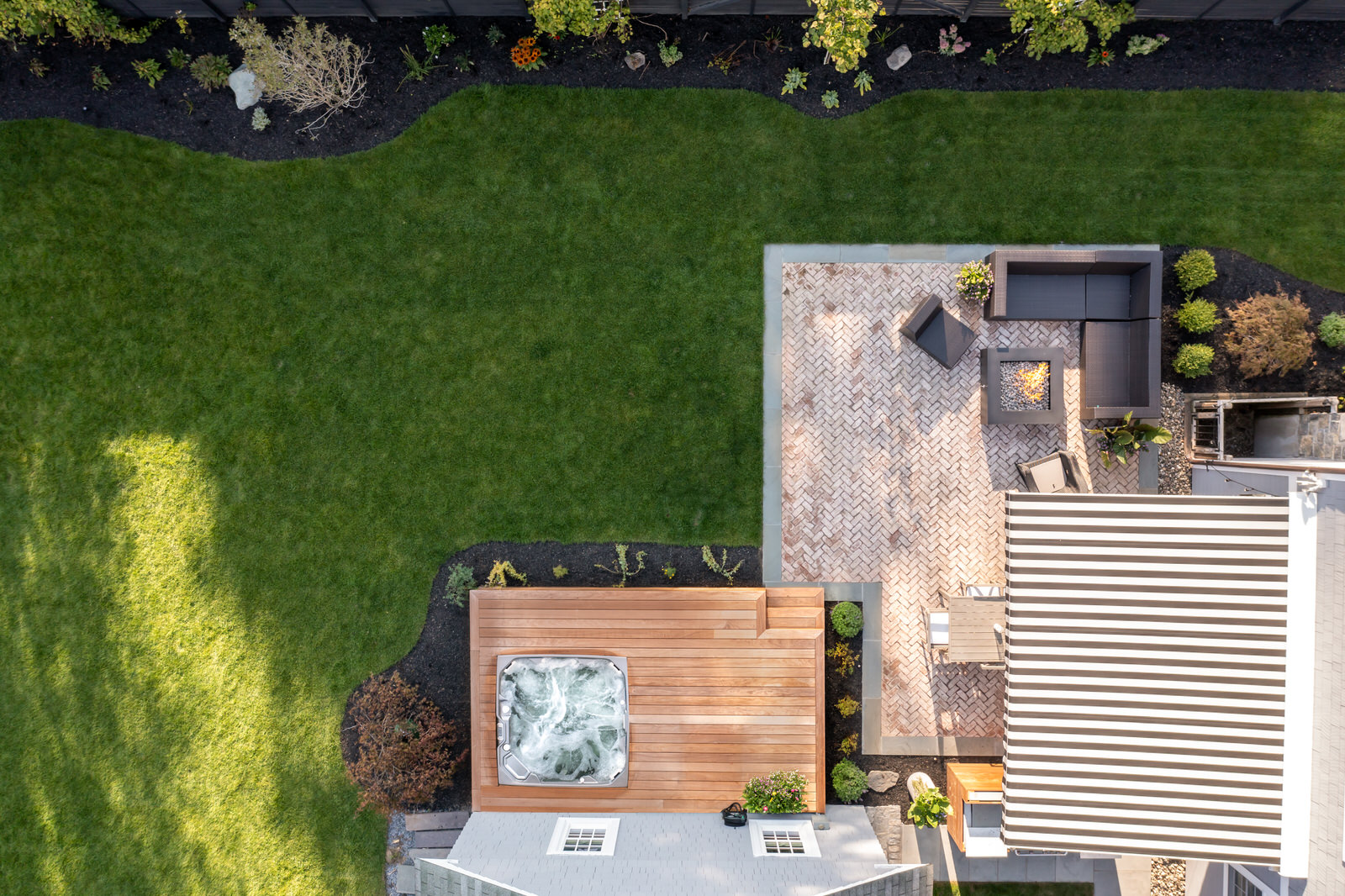
Finally, if you still can’t decide between a stone patio and a wooden deck, keep in mind that wood products and natural stone work very well together, both artistically and stylistically. Having an elevated wooden deck is often nicely accentuated with a lower stone patio. Problem solved.

Start the Conversation

Recent Posts
Follow Us

Continue reading