WEED is a Four-Letter Word!

These are nasty things, weeds. There is a reason they are called noxious, whose synonyms include such words as unhealthy, corruptive and detrimental.

And yet, the battle goes on… Does anyone ever win the battle against weeds?  Only the most diligent and dedicated warriors can, I assure you.  Many people assume that applying a nice thick layer of mulch is the solution to all their problems – not so fast! Yes, the mulch blocks the sunlight and it might work in the short term, but those weeds will eventually grow up through – and even with a plastic barrier beneath they will just start taking root in the mulch itself.

In the long term, the best solution to combat the weed problem, at least in the lawn area, is a thick and healthy lawn – it’s another one of life’s “Catch-22’s,” isn’t it? Weed control can vary depending upon the location you are  trying to protect or reclaim.  In a planting bed mulch is the obvious front line of defense, especially since it has the added benefit of locking in the moisture the the plants and flowers you DO want. But for the lawn areas it becomes a bit more problematic since the best weapons in both the “chemical” and “natural” categories will surely kill the grass as well.  

One of the most well-know non-selective chemical weed killers is Round Up and on the natural side of the equation the most effective seems to be vinegar, salt, bleach or boiling water. But for an already established lawn you might prefer to use a chemical application that is specific to the type of weed or group of weeds but will not harm the grass. But this also is not a sure thing as you need to be aware of the appropriate product for your type of weed, the stage of growth of the weed and the particulars for the application, like safety precautions for children and pets or even the chance of rain!

You may not want to hear this but the most effective ways to remove weeds is using good old fashioned elbow grease and pulling them by hand or with a hand tool.  Sorry. There is an abundance of different types of weed fighting tools to choose from. So you can try to take the easy way out and use an application of some sort (or call your local Green Thumb guy) or you can roll up your sleeves, get some sun and exercise, and get to work!  Good luck in your battle with the weeds.

Recent Posts
Follow Us

Continue reading

Understanding the Value of Design

It can be difficult sometimes to comprehend the value of good design. 

Some clients get the concept right away that investing that little bit of time and money NOW will save you so much time, money and frustration LATER. Other clients have already been through a project and learned the lesson the hard way.  So many times we are called in a year or two after work has been done by the “least expensive” contractor to fix and replace their work. It makes you wonder if they have ever heard the old adage “Do it right the first time”.

Why is it so hard to comprehend the monetary and aesthetic value of good design?  Not just landscape design, but all design.  I am sure that architects, interior designers and even engineers experience this conundrum.

The root of this this problem most likely lies in the concept of “design”.  Most people already have a good idea/image in their mind of what they want, so to spend money for someone to simply draw that idea on a paper seems extravagant and without merit. That would be true if that is all there was to design.  

In reality, the design process is much more complex and comprehensive so that the resulting construction process is that much more uncomplicated and efficient.  All the salient details are considered so that local codes are complied with, construction details are not overlooked, the appropriate materials are chosen and the subcontractors are not duplicating efforts.  

For those contractors that do not do such a thorough job, of course their “number” is going to be lower, but so is their quality, and in the end, so will the client’s bank account!  To borrow a quote from one of our colleagues, “If you think hiring a professional is expensive, just wait to see how much an amateur is going to cost you!”

Recent Posts
Follow Us

Continue reading

Heading to Your Local Nursery?

This time of year most people love to add a splash of color in the front or spruce up a section of the garden with some new plants.  Before you head out to the nursery you should at least take some mental notes and make some general decisions.

For example, are you looking for annuals or perennials? What location? Are you looking for shade, partial shade, or full sun plant material?  Size and shape, ie. growth habit of the plant material, is an important consideration – basically, are you looking for something that will grow tall or stay low and spread?  Evergreen or deciduous? Color preference? Soil type and water needs?

For a seasoned gardener, many of these considerations are automatic and instinctive. However, for a novice gardener or those prone to impulsive purchases (like myself…), thinking about these specifications in advance will save you LOTS of money, especially when you are dealing with perennials, trees or shrubs.  For example, a tree planted on the wrong side of the yard can die simply from not enough or too much sun. Or, a large fast-growing tree planted in the wrong location can cause serious damage to pavement or underground systems. 

Annuals tend to be a little less risky and expensive since they only live for one growing season. On the other hand, annuals only live for one growing season…so they are less economical in the long run.  Spend some time to think about your needs, talk to your local nurseryman and read the tags! 

Want to discuss your project in detail?

Start the Conversation

Recent Posts
Follow Us

Continue reading

Marigolds… You Either Love ’Em or Hate ’Em

The popular orange or yellow annual flower… is not one of my personal favorites… but why do so many people plant them?

Well, they are native to North America, they are very hardy (Hardiness Zone of 3 to 10), they are deer and rabbit resistant AND they even are said to be insect repellent.  Some species have a musky scent that, according to anecdotal evidence, helps keep the mosquitoes and flies away from your deck or patio. 

Marigolds are used in food colorings and as medicinal teas around the world. They are, however, considered to be a noxious invasive plant – possibly why so many people wisely use them as potted plants.

But I just don’t think they are that pretty…maybe from a distance and in large groupings… but to each his own, right?  They just look so much like carnations which bring back bad memories of high school dance corsages…  Go to our Facebook page and let us know what you think of Marigolds.

Recent Posts
Follow Us

Continue reading

Japanese Maple Transplant

Redbud is currently working on a project where the client wisely decided to try and save a beautiful old Japanese Maple tree. 

The tree is approximately 25 feet tall with a head diameter of roughly 25 ft as well.  In order to safely transplant this tree a specialist was consulted.  An enormous whole was dug around the base of this tree which allowed them to dig out the massive 12 foot root ball!  Check out the photos I posted to our Facebook page…

Recent Posts
Follow Us

Continue reading

Wetlands in Our Environment

Most people are only slightly aware of the natural world around them; they take for granted the beauty and importance of nature. We are fortunate to live and work in one of the most beautiful places in the Northeast.

The Saratoga and Southern Adirondack region provides ever-changing views of distant hillsides with spectacular lakes, rivers, and streams. Our region is changing and growing with the addition of new industry, homes and businesses.

Statistics show that Saratoga County grew 10.7% in the last decade and with the Luther Forest/GlobalFoundries venture and other initiatives, this figure could double in the coming decade. The result of this growth is great economic strength but also significant change to our environment. With all the new buildings, roads, parking lots, etc… there can be potential distress on the natural environment.

One natural treasure of our region is our wetlands. Once thought of as wastelands full of mosquitoes, flies and disease, the true importance of wetlands to our environment has only been recognized in recent years. In addition to being a source of food and shelter for many species of birds and mammals, wetlands help regulate water levels, improve water quality, reduce flood and storm damages, and support hunting, fishing and other recreational activities. Scientists now even postulate that wetlands may help moderate global climate conditions.

Wetlands generally exist where groundwater flows near or at the surface, saturating the soil and the root zone of the plants in the area. This is a very limited view as to what defines a wetland. These spaces are very diverse in their makeup and can be found nearly anywhere; low lands, flat lands, mountain tops, rivers edges, ponds, stream banks and so on. However, it does not always have to be wet to be considered a wetland. Soil conditions or the types of vegetation are also useful indicators as certain plants have adapted their roots to grow in wet environments.

We need to reevaluate the areas on our property with dead trees, tall wild sedges, ferns, skunk cabbage and wet, mucky soil. We must begin to appreciate what they offer our environment and rethink our natural inclination to fill in these areas and convert them into lawn. Unfortunately, most people consider wetlands to be unsightly and have a desire to clean them up or transform them into areas of more conventional use.

But there are many ways to make wetlands more attractive without harming them or their environmental benefits. For example, removing some of the dead trees and introducing wetland species of plants like dogwoods, viburnums, asters, iris and many more, will add flower color and interest. Meadow grass mixes can be planted to add wildflowers that will bring color and interest spring, summer, fall and winter. Elevated boardwalks can be used to gain access to these amazing spaces allowing us to more closely observe the plants,

birds, and other animals that live in or visit wetlands. Proper planning and creativity can be used to convert wet spaces into beautiful areas that are compatible with our lifesty

Nearly 75% of all wetlands are privately owned. Nevertheless, because they are such a critical element in our environment, wetlands, no matter their size, are strictly regulated at the federal, state, and local level. Therefore, before making any changes to wet areas on your property, it is essential to determine whether these areas are protected wetlands. This determination may not be obvious and should be made in consultation with a certified wetland delineator or a regulatory agency. You can contact your local building department or the United States Army Corps of Engineers, the New York State Department of Environmental Conservation, or the U.S. Environmental Protection Agency (EPA) to find a wetland delineator.

At the very least, regulation entails a review of your plans and authorization by a governmental agency before any activity can be undertaken. In the event that your plans are more drastic, such as those requiring dredging or filling of a wetland, you may need to go through the permit process. The Army Corps has some general criteria that they apply on an individual basis to each application. The general criteria are: 1. an assessment of need for the proposed work; 2. whether any alternatives that would accomplish the same goal were considered; 3. an analysis of the long-term favorable and/or unfavorable effects on the public and private use of the area.

Wetlands are a vital link between water and land, offering many benefits to our environment, and they do not have to be filled in to be compatible with business or private use. With proper planning and regulatory approval, they can offer unique and inviting landscapes for all to enjoy.

By being aware of the projected growth of our region and what impact it can have on the environment, we can avoid looking back 5, 10 or 15 years from now and being disappointed in what has been done in the name of growth and prosperity. It is easier to work hand in hand with what Mother Nature has already provided for us rather than try to recreate her efforts.

For more information on wetlands, their benefits and regulatory information, contact:

Start the Conversation

Recent Posts
Follow Us

Continue reading

When to Involve a Landscape Architect: Sooner Rather than Later

When designing a new house or renovating an existing home, the design and build process can be lengthy and sometimes overwhelming.

Decisions need to be made constantly. The style of home, the square footage, the floor plan and the building materials are usually of the utmost concern. Coupled with the daily requirements of work, family and domestic tasks, you may wonder how you are going to make it through the process. One’s initial response may be to limit the amount of decisions that need to be made by focusing on the most important aspects. Thinking about where the driveway will be located, how a deck or patio might fit into the picture, the location of a future pool or play space in the backyard, become secondary.

The design team for building new or renovating typically consists of an architect, a builder and homeowner. By including a landscape architect in this group early on you get a complete interior and exterior design team that can help the homeowner to fully develop their vision for the house and how they plan to use the space – inside and out. This type of collaboration results in the creation of a master plan that incorporates all the homeowners’ current and future desires. It also enables the homeowner to prioritize and phase-in portions of the plan over time as their budget allows. It will also prevent costly duplication of efforts down the road.

Landscape architects can assess a property to best situate a new home to allow the maximum amount of sunlight to reach the home and to take advantage of the best possible views. They can assess current plant materials and help to incorporate that 150 year old oak tree that is hidden just beyond the tree line. They will arrange the driveway so that it does not become a focal point of the property but instead flows gracefully while providing enough parking, play areas and appropriate turnarounds.

Having a landscape architect review the plans for the house itself may also prevent you from locating the septic system in or near the optimal location for the (future) pool or help you to position a window to best view a (future) water feature. Or, if the property is sloped so that basement of the house can accommodate a walk-out basement, you may want to consider adding a few yards of concrete to the footing of the house and adding a set of French doors. Because, when you do get around to finishing the basement, wouldn’t it be great to have a patio with a hot tub, barbeque and intimate seating area integrated with the basement?

Including a landscape architect on the design team can help to make sure that any imminent or future exterior projects are taken into account and not made cost prohibitive. In the end, the goal is the same for all – optimal land use at minimal expense.

Start the Conversation

Recent Posts
Follow Us

Continue reading

The Landscape of Technology

Gone are the days of simply putting together some plants and grass and calling it a landscape. Today’s landscapes integrate technology along with plant materials in exciting ways, from built-in barbeques, pools, spas and multifunction athletic courts to customized outdoor audio, lighting, security, and irrigation systems.

More than being used as a finished element in the landscape, however, technology is now part of the landscaping process from inspiration through planning and construction. Consumers rely on the internet and endless cable TV programs for ideas and use computer programs to make simple plans. Landscape designers take even greater advantage of technology with sophisticated programs to design landscapes, integrate systems, ensure local code compliance, and coordinate with other building professionals. The sheer mass of the available technology is daunting, and while it makes innovative solutions in planning and design possible, integrating the various technologies adds another challenge to the planning and design process.

Sometimes employing the latest in high-tech products can empower consumers to move forward with the project of their dreams. For example, previous clients once had serious concerns about installing a pool in their backyard because of the potential safety problems relating to the couple’s two teenage children. It was important to the couple to be able to monitor the pool at all times, but this was impossible when both parents were working. The solution was to install a video camera that could be accessed via an internet video feed which the clients could monitor from their computers at work. Now this family is enjoying their pool and their security with the help of technology.

Another example of how technology can improve the planning and design process is in allowing professionals to communicate effectively and efficiently with their clients and each other. If your landscape designer uses the AutoCad program, he can easily share blueprints with architects, building contractors, and interior designers. Each of these professionals is immersed in their own field of design and products that are available to the consumer. The architect is typically focused directly on the house or building and pays little attention to what the client might be thinking about for the landscape. Proper coordination between the landscape professional and the architect can result in two separate projects that still fit together in both form and function. This planning process is further impacted by the regulatory growth and control our local governments are placing on our communities. For example, houses, pools, walls, etc… have to be set so many feet from a property line; fences are limited to certain heights and styles; and drainage requirements are new realities that need to be considered. All of these factors are made more manageable by computer planning and research.

The vast array of landscape options available through technology sometimes leads consumers to be overwhelmed with the size and complexity of a project. Sometimes the technology may even overshadow the importance of good design and creativity. A landscape designer will help you wade through options and decide what technologies are most appropriate for your landscape while implementing a creative design that’s both attractive and functional. Thorough planning can coordinate traditional landscaping elements with new technology and break even a large, complex project into manageable pieces. The end result of working through the design and planning process effectively provides you with a completed puzzle. All the pieces have a place within a landscape. The trick is to break down that plan into constructible parts. This puzzle can be completed as a whole project or can be pieced together over a period of time. Comprehensive planning allows you the ability to realize your dreams quickly or over a number of years.

Good planning also results in lower project costs due to the ability to perform the work correctly from the outset and laying the groundwork for future additions. For example, while designing your landscape you might plan to build a patio and install an irrigation system right away, but realize that at some point you would like to install an outdoor lighting and audio system, but probably not for a few years. While your patio and irrigation system are being built, a smart landscape designer will have a PVC pipe system installed underneath your patio and throughout your lawn during construction. When the time is right you can add your lighting and audio systems without ruining the lawn or patio. The best part is that when you get ready to actually install the new systems, the labor involved will be so small that you could probably do it yourself!

Consumers with a comprehensive plan can also be secure in the fact that their dollars are being spent wisely, knowing that work is being performed in a logical sequence. Nothing is worse for a consumer or professional than having to do work twice due to poor planning. Getting it done right the first time is essential. Consider the clients who want to install a pool and a new fence surrounding their property – two expensive projects. They decide to spread out their projects and do the fence this year so their kids and dog can run freely in the yard and to build the pool next year. They go ahead and pick out a fence they really like only to find out a year later that the fence does not meet the local code for pool safety, and that half the fence needs to be taken out to make room for the pool contractor anyway. This kind of situation is easily avoided with careful planning.

As we are bombarded with all of the exciting opportunities that technology makes available to us, we can be overwhelmed and lose sight of our true objective. Client and designer need to be careful to consider all the possibilities without losing sight of both the artistic and functional aspects of the project. As you watch home and garden television shows and peruse the internet, consider all the magical possibilities for your landscape, but please do not lose sight of the most important aspect of developing a project – good design and creativity!!!

Start the Conversation

Recent Posts
Follow Us

Continue reading

Stone Patio or Wooden Deck: Which is Better for Your Home?

Spending more time outside is never a bad idea. One of the best ways to enjoy the outdoor is relaxing on a patio or a deck. But which is better for your home — a stone patio or a wooden deck?

The answer is not as simple as it seems and involves careful consideration before investing in what is likely to be the focal point of your outdoor entertaining, play, and relaxation space.

Some people base their decision solely on their personal preference for the look of wood or the feel of stone. Personal preference, however, is only one of several factors to consider. Other factors include the intended function of the new space and what type of structure will work best with the style of your home. The setting of your property is a factor and whether you want to maximize your privacy or a great view. And the very important issues of maintenance and cost are always a factor in decision-making.

Plan Your Patio or Deck Space

When planning your new outdoor space, ask yourself several questions. Will you use the space for small family gatherings or for entertaining large groups of friends? Are your gatherings usually casual or formal? Will you use the space for reading the paper in the morning, sun tanning in the afternoon, or barbecuing in the evening? Do you have small children? The answers to these questions might already lead you in the direction of a material choice. Large, formal gatherings might seem more appropriate on a smooth, dimensional Bluestone patio, whereas small and casual might fit better with a traditional, rustic cedar deck. If you have children or grand-children you might avoid stone altogether for the softer feel of wood.

Next, you should consider the style of your home. Some home styles and finishes (brick, vinyl, wood, etc.) work better with stone patios and others with wooden decks. Think about whether your proposed structure will interfere with windows in your home, and also consider the interior floor finishes of the adjoining room in the home, since you may want to carry over a color, theme, or tile pattern.

Consider the Surroundings of the Patio or Deck

The setting of your property is another factor to consider in deciding between a patio or a deck. Whether your yard is level or steeply sloped is also extremely important and may end up trumping all other factors. Natural stone lends itself especially to level, at-grade installations, while wood is usually preferred for sloping, elevated installations. An at-grade patio makes it easier to create privacy from neighbors. An elevated deck can leave you out in the open, which is exactly where you might want to be if privacy is not an issue. If you want to accentuate a grand vista, an elevated deck might be the preferred option. However, remember that the required railings may interfere with the view you are trying to emphasize.

Maintenance of each type of material is also a significant concern. With proper base preparation to create the correct pitch for water to drain, natural stone requires very little maintenance, perhaps replenishing the sand grout occasionally. There is really no need for any kind of sealing or coloring to preserve a stone patio. It is also easy to wash if desired, and real stone will not lose its color and will never rot. Most wood products do require regular cleaning as well as staining and/or sealing to maintain color and to extend the lifespan of the deck. Wood will also rot, and should be kept dry by providing air circulation above and below decks. If you are considering an artificial composite polywood material because it needs virtually no maintenance, keep in mind that generally such materials have a tendency to stain.

Cost is Always an Issue

Finally, when deciding between a stone patio and a wooden deck, you will have to determine what your options will cost. You must consider not only the cost of the material itself, but how much it will cost to install. Stone is typically an inexpensive product to buy, but expensive to install. It is also very heavy, and might require special equipment to deliver to your construction site. New technology in machining and sawing natural stone is now making it easier and more cost effective to use natural stone. Conversely, the material cost for wood products is usually expensive. Then again, availability of long pieces makes it easy to cover large areas quickly, which can decrease labor costs. Wood can be easier to work with, because it is much lighter, more forgiving, and can be used to create custom shapes. Artificial composites are more difficult to work with than wood and are less forgiving. Finally, changes in elevation or slope can have a significant impact on the cost of construction. Building a stone patio on a slope will typically be more expensive than an elevated wooden deck. In this case the patio would require large amounts of concrete foundation and retaining walls with a stone veneer.

Once you decide on a stone patio or a wooden deck, you must still choose what specific stone or wood you will use. The most typical types of natural stone material used for patios are dimensional stones with a smooth surface, such as New York State style or Pennsylvania style Bluestone or Tennessee Valley stone. Irregular shaped stone, such as Champlain Stone’s Corinthian Granite or South Bay Quartzite, has a rougher, sometimes more rustic appeal. A natural clay brick offers many style and color possibilities as well. The most common varieties of wood decking are Cedar or Mahogany, which come in various thicknesses. There are also some less common choices to consider, such as the Brazilian Redwood Ipe, and Teak. Due to the wide diversity of stains, color possibilities of wood are vast, and with the work of skilled carpenters, style choices are also unlimited.

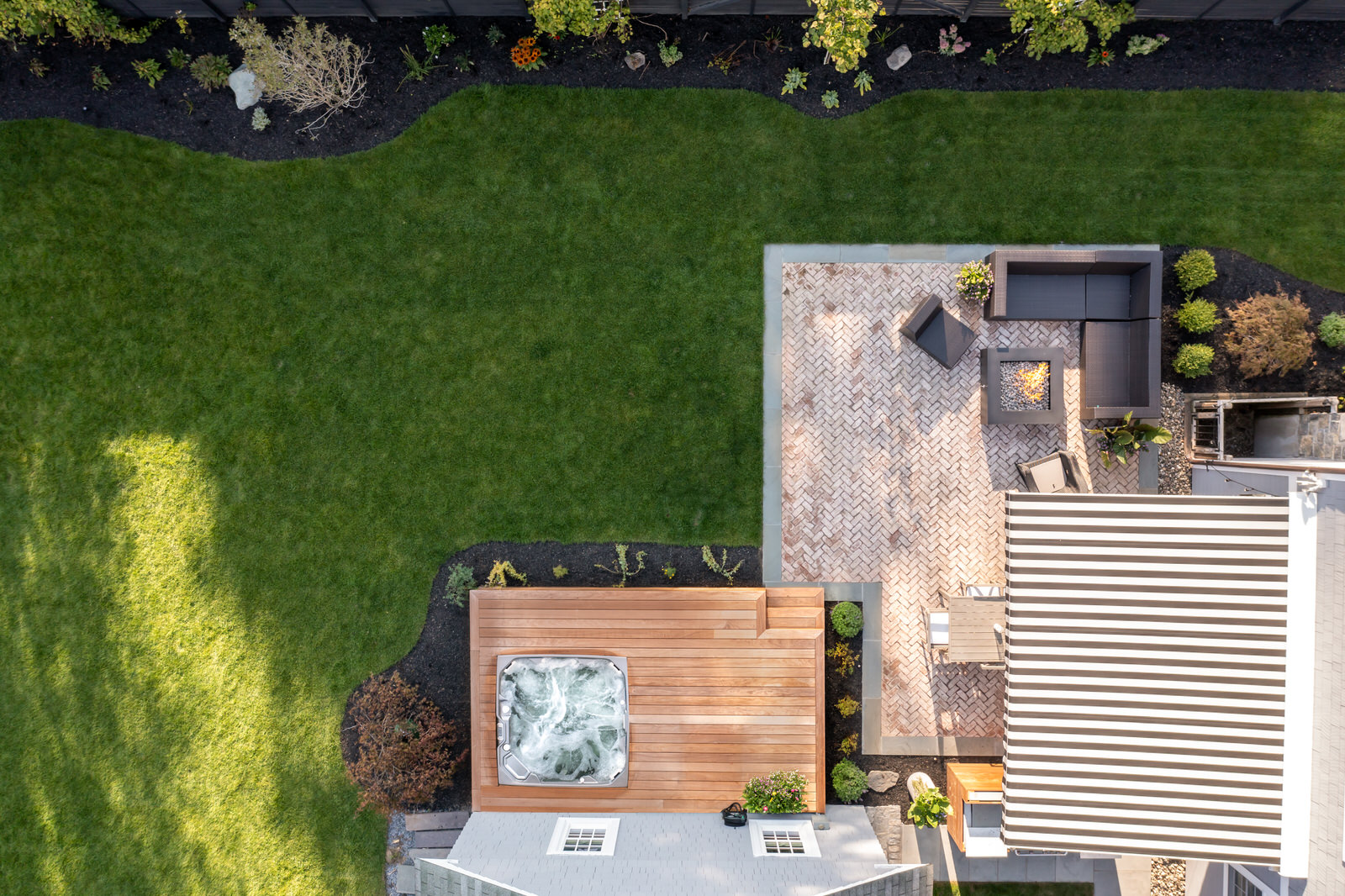
Finally, if you still can’t decide between a stone patio and a wooden deck, keep in mind that wood products and natural stone work very well together, both artistically and stylistically. Having an elevated wooden deck is often nicely accentuated with a lower stone patio. Problem solved.

Start the Conversation

Recent Posts
Follow Us

Continue reading